The Viral Framework: 10 Prompts to Replace Expensive Consultants A viral LinkedIn post recently outlined 10 strategic frameworks you can generate with AI prompts:
SWOT Analysis — 10-12 slide deck with goals, strengths, weaknesses, opportunities, threats, priorities, action listCompetitor Comparison — Who competitors are, pricing, features, pros/cons, 3 moves to winCustomer Persona — 2-3 personas with photos, pains, goals, buying triggers, messagingValue Proposition — Problem, promise, proof points, before/after, tagline, website copyGo-to-Market Launch Plan — Target customer, channels, content calendar, budget, checklistPricing Options — Good/better/best packages, who each is for, discount rules30-60-90 Day Plan — Goals, quick wins, weekly rhythm, stakeholders, risks, checklistsBudget & Break-Even — Costs, expected sales, break-even point, best/base/worst caseRisks & Mitigations — Top risks, likelihood/impact scoring, owners, backup plansCompetitive Positioning — Differentiation, market gaps, messaging anglesThe claim: Use these prompts and replace your $500/hr consultant.
The reality: These prompts give you documents. They don't give you systems.
And documents sit on shelves. Systems actually work.
The Problem: Static Documents vs. Living Systems Let's be clear: These frameworks are excellent. If you run these prompts in ChatGPT or Claude, you'll get:
✅ A beautiful SWOT deck
But what do you DO with them?
The Real Question Strategic documents are useful at the moment they're created. But then:
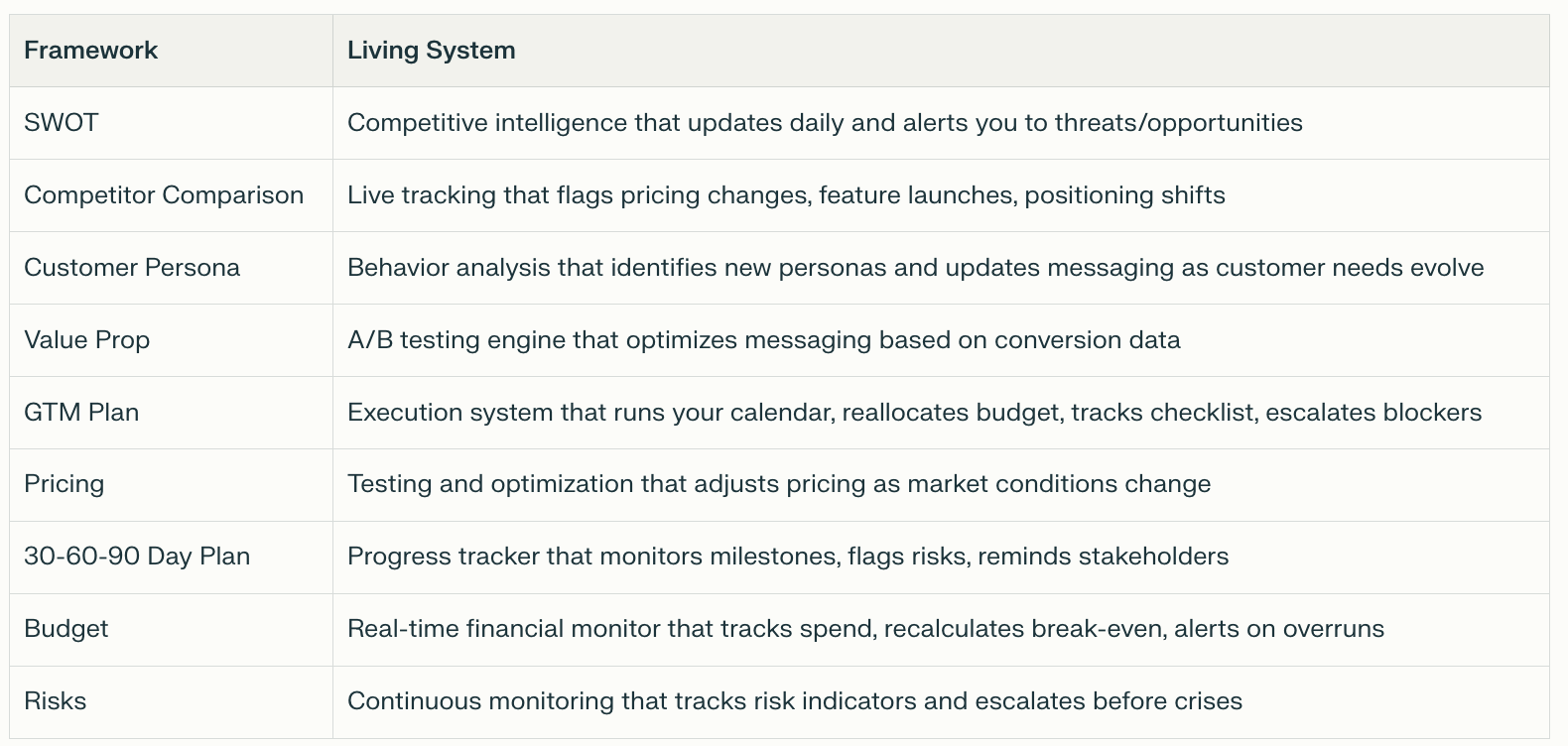
Your competitor launches a new product . Does your Competitor Comparison deck auto-update? No. You have to manually research and edit. A new customer segment emerges . Does your Customer Persona deck auto-expand? No. You have to manually add them. Your pricing changes . Does your Pricing Options deck auto-adjust? No. You have to manually rewrite it. You miss a 30-day milestone . Does your 30-60-90 Day Plan auto-recalibrate? No. You have to manually reschedule. Every one of these frameworks becomes stale the moment your business changes.
And businesses change constantly.
The Dyntyx Perspective: Agents That Own Strategy Execution What if, instead of static decks, you had orchestrated AI agents that:
Monitor your competitive landscape continuously Update customer personas based on new data signals Adjust your GTM plan as channels perform Track your 30-60-90 day plan and escalate when you're behind Recalculate break-even as costs or sales velocity change Alert you to new risks as they emerge That's not prompt engineering. That's orchestration.
Let's walk through each framework and show what it looks like when agents own it—not just generate it.
Framework 1: SWOT Analysis → Continuous Competitive Intelligence Agent A 10-12 slide SWOT deck with:
Strengths, Weaknesses, Opportunities, Threats Top 5 priorities 30-day action list What an Agent Does Agent: Competitive Intelligence Monitor
Responsibilities:
Scrapes competitor websites weekly for new products, pricing changes, partnerships Monitors news sources for industry threats (regulatory changes, market shifts, new entrants) Flags opportunities (e.g., competitor raised prices, you can undercut) Updates SWOT deck automatically in real-time Alerts leadership when a major change happens (e.g., "Competitor just launched feature X—we're now behind on Y") Result: Your SWOT isn't a snapshot from January. It's a living document that evolves with the market.
Human role: Review alerts weekly, decide which opportunities to pursue.
Framework 2: Competitor Comparison → Competitive Tracking Agent A 10-12 slide deck with:
Who competitors are Price/feature comparison table Pros/cons 3 moves to win in 90 days What an Agent Does Agent: Competitor Tracker
Responsibilities:
Tracks competitor pricing (scrapes their website, monitors public announcements) Monitors feature releases (changelog tracking, product hunt launches, press releases) Builds a live comparison table (you vs. competitors across 10-15 dimensions) Flags when competitor pricing changes ("Competitor A dropped prices 15%—should we respond?") Tracks your "3 moves to win" checklist and escalates if tasks fall behind Result: You're never surprised by competitor moves. You see changes as they happen.
Human role: Decide how to respond to competitor shifts. Agent shows you what changed; you decide strategy.
Framework 3: Customer Persona → Customer Behavior Intelligence Agent 8-10 slide deck with:
2-3 personas (photo, quote, pains, goals, buying triggers, channels, messaging) What an Agent Does Agent: Customer Behavior Analyst
Responsibilities:
Monitors customer behavior across your site, product, support tickets, sales calls Identifies new personas emerging (e.g., "We're getting signups from construction managers—new persona?") Tracks which messaging resonates per persona (A/B test results, email open rates, landing page conversions) Updates persona pains/goals based on support ticket trends and sales objections Flags when a persona's behavior shifts (e.g., "CFOs are now asking about AI governance—update persona?") Result: Your personas evolve as your customer base evolves. You're not working from stale 2024 data.
Human role: Review persona updates monthly, approve new persona additions.
Framework 4: Value Proposition → Messaging Testing & Optimization Agent 8-10 slide deck with:
Problem statement Promise statement 3 proof points Before/after example Tagline options Website hero copy What an Agent Does Agent: Value Prop Optimizer
Responsibilities:
A/B tests value prop variants on your homepage (5 different hero copy versions) Tracks which tagline drives the highest conversion (visitor → signup) Monitors which proof points resonate in sales calls (by analyzing call transcripts) Updates website copy automatically when a new variant wins Alerts when your value prop is underperforming (low conversion rate, high bounce rate) Result: Your value prop isn't static. It's constantly tested and optimized based on real customer behavior.
Human role: Review winning variants, approve changes before they go live.
Framework 5: Go-to-Market Launch Plan → GTM Execution Agent 12-14 slide deck with:
Target customer Simple message Channels (email, social, partners) 4-week content calendar Budget split Launch checklist What an Agent Does Agent: GTM Coordinator
Responsibilities:
Executes 4-week content calendar (schedules posts, sends emails, tracks engagement) Monitors channel performance (email open rates, social engagement, partner referrals) Reallocates budget to winning channels automatically (e.g., LinkedIn is outperforming email—shift $500 to LinkedIn ads) Tracks launch checklist (landing page live? Email sequences built? Sales deck ready?) Escalates blockers ("Landing page design is overdue—escalate to marketing lead") Result: Your GTM plan doesn't sit in a deck. It runs autonomously with human oversight.
Human role: Review weekly performance, approve budget reallocations, join key partner calls.
Framework 6: Pricing Options → Dynamic Pricing Agent 8-10 slide deck with:
Good/better/best packages What's included in each Who each package is for Discount rules Clear recommendation What an Agent Does Agent: Pricing Optimizer
Responsibilities:
Tracks which pricing tier converts best (good vs. better vs. best) Monitors competitor pricing changes (alerts if competitor undercuts you) Tests discount strategies (10% off vs. free trial vs. money-back guarantee) Flags when pricing is a deal-breaker ("50% of lost deals cite price—consider adjustment?") Tracks revenue impact of pricing experiments Result: Your pricing isn't set-it-and-forget-it. It adapts to market conditions and customer behavior.
Human role: Approve pricing changes, decide discount thresholds, review revenue impact.
Framework 7: 30-60-90 Day Plan → Execution Tracker Agent 10-12 slide deck with:
Goals for day 30, 60, 90 Quick wins Weekly rhythm Stakeholders Risks Checklists What an Agent Does Agent: 30-60-90 Execution Monitor
Responsibilities:
Tracks all milestones daily (did we hit the week 1 goal? week 2?) Sends weekly progress reports to stakeholders Flags at-risk milestones ("Week 3 goal is overdue—escalate to project lead") Updates risks based on what's actually happening (e.g., "Dependency on engineering team is causing delays—add to risk list") Reminds you of weekly rhythm activities ("Weekly all-hands is tomorrow—agenda ready?") Result: Your 30-60-90 day plan doesn't become a forgotten deck. It's actively monitored and updated.
Human role: Review weekly progress, decide how to resolve blockers, communicate with stakeholders.
Framework 8: Budget & Break-Even → Financial Tracking Agent 8-10 slide deck with:
Costs list Expected sales Break-even point Best/base/worst case scenarios Money-saving ideas What an Agent Does Agent: Budget Monitor
Responsibilities:
Tracks actual spend vs. budget in real-time (pulls from Stripe, QuickBooks, expense tools) Monitors sales velocity (are we on track to hit expected sales?) Recalculates break-even point as costs or sales change Alerts when you're over budget ("Marketing spend is 20% over—review immediately") Flags when break-even timeline is shifting ("Sales are slower than expected—break-even pushed to Q3") Result: Your budget isn't a static forecast. It's a living model that adjusts as your business does.
Human role: Review monthly budget variance, approve over-budget items, decide on cost cuts.
Framework 9: Risks & Mitigations → Risk Monitoring Agent 8-10 slide deck with:
Top risks in plain words Likelihood/impact scoring (red/yellow/green) Owner for each risk Backup plan What an Agent Does Agent: Risk Monitor
Responsibilities:
Monitors risk indicators continuously (e.g., "Key vendor contract expires in 30 days—risk escalating") Tracks mitigation progress ("Backup plan for risk #3 is 50% complete") Alerts when risk likelihood increases ("Churn rate spiked—customer retention risk now red") Escalates to risk owners when action is needed Builds weekly risk report for leadership Result: Risks aren't static. They're monitored in real-time and escalated before they become crises.
Human role: Review risk updates weekly, approve mitigation plans, reassign risk owners.
Framework 10: Competitive Positioning → Positioning Testing Agent (Implied from other frameworks: differentiation, market gaps, messaging angles)
What an Agent Does Agent: Positioning Optimizer
Responsibilities:
Tests positioning messaging across channels (website, ads, sales decks) Monitors which differentiation claims resonate (e.g., "speed" vs. "cost savings" vs. "ease of use") Tracks competitor positioning shifts (did they start claiming "fastest" too?) Updates positioning deck when a new angle wins Flags when your positioning is being copied (competitor just launched "AI agents for workflow automation"—same as us) Result: Your positioning evolves as the market does. You're not stuck with 2024 messaging in 2026.
Human role: Approve positioning changes, decide how to differentiate when competitors copy you.
The Fundamental Difference: Documents vs. Systems What Agents Give You Documents are snapshots. Systems are ongoing.
Why This Matters for Your Business Here's the thing: A $500/hr consultant doesn't just hand you a SWOT deck and leave.
They:
Monitor the market for you Track your competitors for you Analyze your customer data for you Test your messaging for you Keep you on track for your 30-60-90 goals Alert you when risks emerge Update your strategy as conditions change That ongoing work is what you're actually paying for.
The deck is just the artifact.
The AI Prompt Trap If you replace your consultant with 10 ChatGPT prompts, you get the artifacts—but you lose the ongoing work.
You have the SWOT deck. But who's monitoring competitors?
You are. Manually.
And if you're a founder or small team, you don't have time for that.
The Dyntyx Solution: Orchestrated Agents What if you could have the artifacts AND the ongoing work—without paying $500/hr forever?
That's what orchestrated agents do:
Generate the initial frameworks (SWOT, personas, GTM plan, etc.) Monitor the data sources continuously (competitors, customers, financials, risks) Update the frameworks automatically as conditions change Execute tactics autonomously (schedule posts, send emails, track milestones) Escalate to you when judgment is needed You get the consultant's ongoing work—at a fraction of the cost.
Scenario: You're Launching a New Product Traditional approach (using prompts):
Run the 10 prompts → get 10 decks Present SWOT to leadership → approved Build Customer Personas → use in marketing copy Set pricing → add to website Launch GTM plan → manually execute for 2 weeks Get busy with other work → GTM plan stalls Competitor launches similar product → you don't notice for 3 weeks Customer feedback reveals new persona → you don't update docs Pricing isn't working → you don't adjust for 2 months Result: Strategy became stale 30 days after launch.
Dyntyx approach (using orchestrated agents):
Generate the 10 frameworks with agents Deploy agents to monitor and execute:Competitive Intelligence Agent tracks competitors dailyCustomer Behavior Agent monitors signups, support tickets, sales callsGTM Coordinator Agent executes content calendar, tracks performancePricing Optimizer Agent A/B tests pricing tiersRisk Monitor Agent tracks launch risks Week 2: GTM Agent flags that LinkedIn is outperforming email—reallocates budgetWeek 3: Competitive Agent alerts: "Competitor launched similar product—pricing 20% lower"Week 4: Customer Agent identifies new persona: "We're getting signups from legal ops—new use case"Week 5: Pricing Agent suggests: "Better tier is underperforming—test discount strategy"Week 8: Risk Agent escalates: "Churn spiked 15%—customer retention risk now red"Result: Your strategy evolves in real-time. You're never working from stale data.
The ROI Comparison: Option 1: Hire a $500/hr Consultant Cost:
Initial strategy work: 20 hours = $10,000 Ongoing monitoring/updates: 10 hours/month = $5,000/month Annual cost: $70,000 What you get:
High-quality frameworks Expert judgment Ongoing monitoring and updates What you lose:
Expensive (most startups/SMBs can't afford this) Dependent on consultant availability Knowledge walks out the door if consultant leaves Option 2: Use 10 AI Prompts (DIY) Cost:
ChatGPT Pro: $20/month = $240/year What you get:
10 strategic frameworks High-quality documents Total control What you lose:
No ongoing monitoring You have to manually update everything You have to manually execute (GTM, pricing tests, risk tracking) Takes 20+ hours/month of your time to maintain Hidden cost: 20 hours/month × $200/hr (founder time) = $4,000/month = $48,000/year
Option 3: Dyntyx Orchestrated Agents Cost:
Agent orchestration platform: ~$2-5k/month Annual cost: $24-60k What you get:
All 10 frameworks generated Agents that monitor and update continuously Agents that execute tactics (GTM, pricing tests, risk tracking) Escalation to humans when judgment is needed Your team stays in control What you save:
$10-46k/year vs. consultant 20 hours/month of founder time ROI:
What This Looks Like in Practice Run the 10 framework prompts (or have Dyntyx agents generate them) Deploy agents to monitor data sources:Competitive Intelligence Agent → scrapes competitor sites, news Customer Behavior Agent → connects to analytics, CRM, support tools GTM Coordinator Agent → connects to email, social, ads platforms Pricing Optimizer Agent → connects to Stripe, website analytics Risk Monitor Agent → connects to project tools, financials Budget Monitor Agent → connects to QuickBooks, Stripe 30-60-90 Tracker Agent → connects to project management tools Set escalation rules: "When should agents alert me vs. handle it autonomously?" Month 2-12: Ongoing Execution Weekly:
Agents send you a digest: "Here's what changed this week"Competitor X launched feature Y Customer persona Z is emerging (20 signups from legal ops) LinkedIn ads are outperforming email (reallocated $500) Week 6 milestone is overdue (escalated to project lead) Monthly:
Agents update all frameworks automaticallySWOT deck reflects new competitor moves Customer persona deck includes legal ops persona GTM plan shows updated budget allocation 30-60-90 plan shows actual progress vs. plan Quarterly:
You review with leadership:What changed in the market? What new opportunities emerged? Where are we ahead/behind? What should we adjust for Q2? Human time invested: 2-3 hours/week reviewing agent updates and making decisions.
Agent time invested: 24/7 monitoring, updating, executing.
The Strategic Frameworks Agents Can't Replace (Yet) Let's be honest: Agents can't replace everything a consultant does.
Agents can't (yet):
✗ Build trusted relationships with your leadership team ✗ Navigate company politics ("This exec doesn't trust AI—frame it differently") ✗ Make high-stakes judgment calls ("Should we pivot the business model?") ✗ Facilitate workshops with 10 stakeholders who disagree ✗ Provide the "been there, done that" wisdom from 20 years of experience Agents CAN:
✓ Monitor data continuously (competitors, customers, financials) ✓ Execute tactical work (send emails, schedule posts, track milestones) ✓ Update frameworks automatically (SWOT, personas, pricing, risks) ✓ Test and optimize (messaging, pricing, channels) ✓ Escalate to humans when judgment is needed The sweet spot: Agents handle the 70% of ongoing work (monitoring, updating, executing). Humans handle the 30% that requires judgment, relationships, and strategic thinking.
Implementation: Step 1: Generate Your Frameworks Run the 10 prompts (or use Dyntyx agents to generate them):
SWOT Analysis Competitor Comparison Customer Personas Value Proposition GTM Launch Plan Pricing Options 30-60-90 Day Plan Budget & Break-Even Risks & Mitigations Competitive Positioning (implied) Time: 2-4 hours
Step 2: Identify What Should Be "Living Systems" Ask: Which of these frameworks need ongoing monitoring and updating?
High priority (deploy agents first):
Competitive Intelligence → things change fast Customer Behavior → personas evolve GTM Execution → requires daily execution Risk Monitoring → risks escalate quickly Medium priority:
Pricing Optimization → test quarterly Budget Tracking → review monthly 30-60-90 Execution → review weekly Low priority (keep as static docs for now):
SWOT (update quarterly manually) Value Prop (test quarterly manually) Step 3: Deploy Agents Connect agents to your data sources:
Competitive Intelligence Agent → competitor websites, news APIs, industry trackersCustomer Behavior Agent → Google Analytics, HubSpot, Intercom, sales call transcriptsGTM Coordinator Agent → Mailchimp, LinkedIn, Twitter, Google AdsPricing Optimizer Agent → Stripe, website analyticsRisk Monitor Agent → Asana, Jira, financial toolsBudget Monitor Agent → QuickBooks, Stripe, expense trackingTime: 1-2 weeks (with Dyntyx support)
Step 4: Set Escalation Rules Decide when agents should handle things autonomously vs. escalate to you:
Agents handle autonomously:
Schedule social posts (GTM Agent) Update competitor pricing table (Competitive Agent) Flag new customer persona emerging (Customer Agent) Send weekly progress reports (30-60-90 Agent) Agents escalate to human:
Competitor launched major new product (Competitive Agent → alert leadership) Budget is 20%+ over (Budget Agent → escalate to CFO) High-impact risk moved from yellow to red (Risk Agent → escalate to project lead) New persona requires messaging overhaul (Customer Agent → escalate to marketing) Step 5: Review & Optimize Weekly: Review agent digest (15-30 min)Monthly: Review updated frameworks (1-2 hours)Quarterly: Strategic review with leadership (2-4 hours)
Total human time: 2-3 hours/week
The Future: Prompt Engineering vs. Orchestration 2024-2025: "Use ChatGPT prompts to replace consultants!"
Reality: Prompts generate great documents. But documents sit on shelves. You still need humans to monitor, update, execute.
2026+: "Use orchestrated agents to replace the ongoing work consultants do."
Reality: Agents continuously monitor data, update frameworks, execute tactics, escalate when judgment is needed. Humans focus on strategy and relationships.
The shift: From static artifacts → living systems.
Final Thought: Documents vs. Systems The 10 AI prompts framework is excellent. It shows you what strategic frameworks you need and how to generate them fast.
But frameworks alone aren't enough.
You don't need better documents. You need better systems.
Systems that:
Monitor your market continuously Update your strategy as conditions change Execute your tactics autonomously Escalate to you when judgment is needed That's not prompt engineering. That's orchestration.
And that's what Dyntyx builds.
Call to Action If you're using the 10 prompts framework (or thinking about it), ask yourself:
Who's going to monitor competitors after I generate the SWOT deck? Who's going to track customer behavior shifts after I create personas? Who's going to execute my GTM plan after I build the calendar? Who's going to update my pricing as the market changes? If the answer is "me, manually," you're missing the orchestration layer.
Let's talk about how orchestrated agents could turn your strategic frameworks into living systems.