The 2026 AI Agent Operating Model: The Ultimate Guide to Integrating AI Agents into Your Company
Published On -
February 28, 2026
AI is no longer coming for jobs—it's already here. Independent analysis estimates 200,000–300,000 U.S. jobs were displaced or foregone due to AI in 2025 alone. But while headlines focus on layoffs, a quieter revolution is unfolding: companies deploying AI agents are achieving 20–40% operational efficiency gains, 30–50% cycle time reductions, and seeing measurable ROI in as little as 6–8 weeks.
The difference between companies that get crushed by AI and those that dominate with it comes down to one thing: whether they treat AI as a tool or as a new operating model.
This comprehensive guide examines:
The quantified scope of AI job displacement in 2024–2026 and strategic workforce implications
Why 2026 represents the inflection point from AI experimentation to production-scale autonomous agents
The documented 40% failure rate of agentic AI projects and evidence-based mitigation strategies
High-ROI use cases delivering hundreds of thousands in annual value across professional services, financial services, healthcare, and other industries
A proven framework for deploying orchestrated AI agent systems in 8–12 weeks with measurable business outcomes
How forward-thinking organizations are leveraging AI to accelerate growth, not merely reduce costs
The strategic rationale for partnering with specialized AI implementation firms versus internal development
By the conclusion of this whitepaper, executives and operational leaders will possess a clear, actionable roadmap for integrating AI agents into their organizations in 2026—grounded in real-world implementation data, industry benchmarks, and practical governance frameworks.
Chapter 1: The AI Layoff Reality Check
The Documented Reality of AI-Driven Workforce Displacement
The conversation surrounding AI and employment has shifted from theoretical projection to empirical reality. While public discourse remains focused on speculative scenarios, quantitative analysis reveals that displacement is already underway—though often obscured by conventional workforce metrics.
In 2025, independent research estimated that AI displaced or prevented the hiring of 200,000–300,000 workers in the United States—representing approximately 0.13–0.20% of nonfarm employment. While this percentage appears modest in isolation, several factors indicate the true scale of impact:
Attribution challenges: The documented figures represent only cases where organizations explicitly cited AI as a factor in workforce decisions. Industry observers note that most AI-related displacement occurs through mechanisms that do not trigger formal reporting requirements—including strategic attrition, selective hiring freezes, role consolidation, and productivity-driven headcount optimization.
Methodological limitations: Traditional labor market statistics were designed to capture conventional displacement patterns (plant closures, mass layoffs, economic downturns) rather than technology-mediated productivity shifts. Outplacement and workforce consulting data suggest that AI-attributed job losses represent a small fraction of actual AI-driven displacement, as most organizations avoid explicit attribution to minimize reputational and regulatory scrutiny.
Accelerating trajectory: Global economic analysis projects that tens of millions of jobs worldwide could be directly displaced by 2030, with certain occupational categories facing exposure rates exceeding 50%. The 2025 displacement figures represent early-stage adoption; enterprise AI deployment is expected to accelerate significantly in 2026–2028 as orchestrated agent systems mature and governance frameworks stabilize.
Sectoral concentration: Displacement to date has concentrated in administrative support, data entry, basic content creation, tier-1 customer service, and routine analytical tasks. However, 2026 deployments increasingly target professional services workflows—including aspects of accounting, legal research, financial analysis, and clinical documentation—previously considered resistant to automation.
Social Media Sentiment Analysis: A Framework for Understanding Workforce Response
While quantitative labor data provides aggregate insight, social media discourse reveals the psychological and organizational dynamics of AI-driven workforce transformation. Analysis of professional networking platforms, industry forums, and anonymous discussion communities illuminates patterns not visible in formal reporting channels.
Framework for interpreting social signals:
Organizations evaluating AI agent deployment should monitor these platforms not for anecdotal validation, but to understand:
Communication strategy gaps: Where official organizational messaging diverges from employee perception
Change management resistance points: Specific workflow changes triggering fear or opposition
Skills gap identification: Tasks employees believe are vulnerable to automation
Reskilling opportunities: Capabilities workers are proactively developing in response to AI
Competitive intelligence: How other organizations in your sector are positioning AI transformation
Observed patterns across platforms:
LinkedIn (professional positioning):
Executive narratives emphasizing "AI-augmented productivity" and "strategic reorganization"
Mid-level managers documenting reduced span of control and consolidated reporting structures
Individual contributors highlighting AI tool proficiency as career differentiation
Sectoral concentration in marketing services (30–40% content team reductions), customer operations, and back-office functions
X/Twitter (real-time reaction):
Immediate workforce impact disclosure from affected individuals
Sharing of employer communications explicitly linking AI capabilities to headcount decisions
Freelancer and contractor communities reporting demand erosion in routine deliverables
Unfiltered discussion of organizational AI initiatives and anticipated workforce implications
Detailed tactical questions about career resilience and skill development
Ethical dilemmas regarding cooperation with AI implementation targeting own roles
Early warning indicators of organizational AI pilots and their subsequent impact
Strategic application for executives:
Rather than dismissing social media discourse as "fear-mongering," forward-thinking leadership teams use these channels to:
Calibrate internal communication strategies before formal announcements
Identify specific employee concerns requiring proactive response
Benchmark peer organization approaches and learn from their execution mistakes
Understand which roles employees themselves perceive as vulnerable (often more accurate than external consultants)
The emotional intensity of social media discourse around AI displacement is itself strategically relevant data. Organizations that acknowledge legitimate workforce concerns while articulating clear transition strategies demonstrate materially higher AI adoption success rates and lower implementation resistance.
Empirical Research: Quantifying Workforce Exposure and Adaptation Capacity
Multiple independent research institutions have published analyses of AI's labor market impact, employing different methodologies but reaching convergent conclusions regarding scale, timing, and sectoral distribution.
The Brookings research program on AI and labor markets developed a framework for assessing worker "adaptation capacity"—the combination of educational attainment, occupational flexibility, geographic mobility, and access to reskilling resources. Key findings include:
Significant heterogeneity in AI exposure across occupational categories, with some roles facing minimal immediate risk while others show 60–80% task susceptibility
Millions of U.S. workers in high-exposure occupations demonstrate limited adaptation capacity absent substantial reskilling investment
Workers in mid-skill occupations (requiring some specialized training but not advanced degrees) face particular vulnerability, as they lack both the credential protection of high-skill roles and the difficult-to-automate physical presence of many low-skill roles
Geographic concentration of AI-vulnerable employment in specific metropolitan areas and rural regions, creating potential for localized economic disruption
Goldman Sachs global workforce analysis:
Goldman Sachs' research team modeled AI impact across global labor markets, projecting:
Potential exposure affecting hundreds of millions of jobs worldwide over the next decade
Certain economic sectors facing task automation rates exceeding 50%, though full job displacement rates significantly lower due to emergence of new tasks
Differential impact by geography, with advanced economies experiencing earlier and more extensive penetration
Productivity gains potentially offsetting displacement through economic growth and new job category creation, though with substantial lag periods and distributional inequalities
Stanford Digital Economy Lab longitudinal tracking:
Stanford researchers conducting longitudinal analysis of AI-exposed occupations identified:
Measurable employment declines in specific occupational categories correlating with AI capability improvements
Characterization of affected workers as "canaries in the coal mine"—early indicators of broader displacement patterns
Wage pressure in roles adjacent to AI-automated tasks, even where outright displacement has not occurred
Preliminary evidence of skill premium shifts, with certain technical and interpersonal capabilities commanding increased compensation while routine cognitive work experiences wage stagnation
Industry-specific tracking (2025–2026):
Sector-level employment data shows acceleration in AI-attributed workforce changes:
Administrative support: 15–25% headcount reduction in organizations deploying document processing and scheduling agents
Data entry and basic analysis: 30–45% capacity reduction through automated extraction and reconciliation systems
Content creation (routine): 20–35% reduction in marketing services firms utilizing generative AI for blog posts, social media, and basic copywriting
Tier-1 customer service: 25–40% reduction in human agent requirements where AI handles common inquiry types with escalation protocols
Synthesis and strategic implications:
The research consensus indicates:
Displacement is real and accelerating but remains in early stages relative to projected long-term impact
Timing uncertainty persists regarding how quickly AI capabilities will expand from routine to complex cognitive tasks
Adaptation pathways exist but require proactive organizational investment in workforce development
Distributional effects matter more than aggregate statistics—certain occupations, demographics, and geographies will experience concentrated impact
Policy response remains inadequate relative to the scale of likely disruption, placing greater burden on individual organizations to manage transition
For organizational leaders, the strategic question is not whether AI will affect workforce composition, but how to position the organization as a beneficiary rather than victim of this transition.
Strategic Framing: From Defensive Posture to Competitive Advantage
The fundamental strategic error most organizations make is framing AI workforce impact as a threat to be mitigated rather than an opportunity to be captured.
The binary strategic choice:
Organizations face two distinct paths:
Path A: Reactive displacement management
Monitor AI capabilities and respond as competitors force market changes
Deploy AI defensively to match competitor cost structures
Manage workforce reductions through attrition and tactical restructuring
Accept margin pressure and market share erosion during transition period
Struggle to attract and retain talent as organization develops reputation for defensive cost management
Path B: Proactive operating model transformation
Systematically redesign workflows around AI agent capabilities
Deploy AI offensively to capture competitive advantages in speed, quality, and customer experience
Strategically redeploy freed workforce capacity to growth and innovation initiatives
Establish market leadership during competitor confusion and hesitation
Position organization as destination for talent seeking to work with cutting-edge AI augmentation
Empirical performance differential:
Early data from organizations deploying orchestrated AI agent systems reveals significant performance separation:
Organizations pursuing Path B demonstrate 20–40% operational efficiency improvements within 8–12 weeks of deployment
These same organizations redirect freed capacity to revenue-generating activities, achieving growth acceleration of 15–30% over baseline projections
Path B organizations report higher employee satisfaction scores, counter-intuitively, as elimination of routine work enables focus on higher-value activities
Customer satisfaction metrics improve 10–25% as AI agents provide faster, more consistent service with intelligent escalation to human experts
In contrast, Path A organizations experience:
Similar cost reduction percentages but directed entirely to margin defense rather than growth investment
Employee morale challenges and talent retention difficulties
Customer experience inconsistency during extended transition periods
Competitor capture of market leadership positions during organizational hesitation
The agent-based operating model:
The performance differential stems from a fundamental architectural choice: treating AI as workflow automation (replacing discrete tasks) versus treating AI as an orchestrated digital workforce (owning end-to-end processes).
Leading organizations in 2026 are deploying multi-agent systems where:
Individual AI agents own specific workflow responsibilities
Agents coordinate with each other and with human team members
Escalation protocols ensure human judgment applied where most valuable
Continuous learning loops optimize agent performance based on outcomes
This represents a new operating model, not merely new tooling. Organizations that recognize this distinction early establish sustainable competitive advantages, while those treating AI agents as "better automation" achieve only incremental improvements.
The remainder of this whitepaper provides a comprehensive framework for organizations committed to Path B—proactive transformation for competitive advantage—including technical architecture principles, governance requirements, implementation methodologies, and partnering strategies.
Chapter 2: From Tools to AI Agents—What Changed in 2026
The End of the Pilot Phase
If 2023–2024 was the "ChatGPT moment" where everyone experimented with prompts, and 2025 was the year of cautious pilots, 2026 is the year AI agents go to war.
Here's what shifted:
Market acceleration:
The AI agents market is growing at ~46.3% CAGR—significantly faster than traditional enterprise software
By 2028, Gartner expects about 15% of routine work decisions to be made autonomously by agentic AI, up from essentially zero in 2024
Enterprise adoption hits mainstream:
52% of executives say their organization is actively using AI agents, with many launching more than ten agent deployments
79% of surveyed executives report AI agents are already adopted in their companies
66% see measurable productivity value from agent implementations
From tools to teammates:
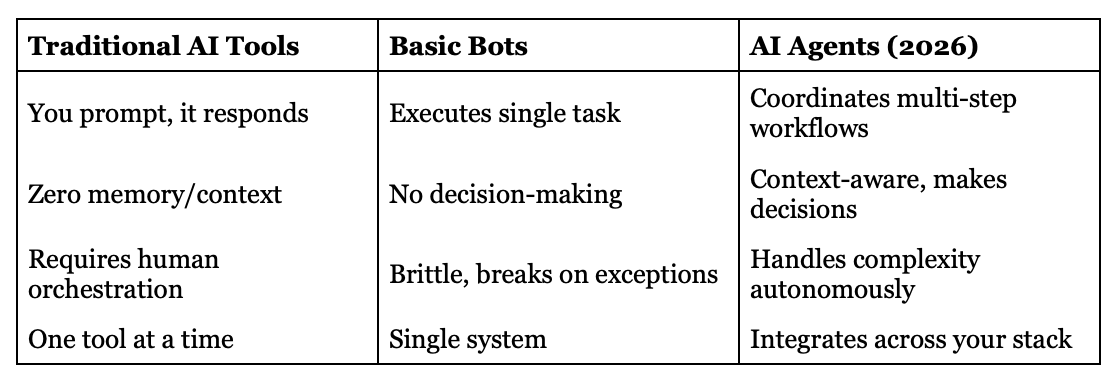
Early AI was a tool: you asked it questions, it answered
2026 AI agents are autonomous digital workers that own entire workflows end-to-end
What Makes AI Agents Different
The Dyntyx Definition: Orchestrated Agent Systems
Most automation fails because it's too narrow. One bot reads emails. Another updates your CRM. A third sends notifications. When something unexpected happens, everything breaks and a human has to jump in and fix it manually.
This is why automation often disappoints—it solves the easy 20% of work and leaves you with the harder 80%.
Dyntyx builds orchestrated agent systems that coordinate across your entire stack, understand context, and handle complexity autonomously:
One agent reads and classifies a request
A second checks your CRM for history
A third routes to the right team based on urgency and type
A fourth handles follow-up and closes the loop
Instead of isolated bots, you get autonomous workflows that behave like a smart team.
Result: Teams save 20–40% of operational time. Cycle times compress by 30–50%. Escalations are rare and include full context when they happen. Launch in 8–12 weeks. See measurable ROI from week one.
Why "Agents" Is the Right Word
The shift from "AI tools" to "AI agents" isn't just marketing—it reflects a fundamental change in how AI operates in business:
Agency: Agents act on your behalf without constant supervision
Autonomy: They make decisions within defined guardrails
Orchestration: They coordinate with other agents and systems
Accountability: They maintain audit trails and escalate when needed
Not AI as a tool your team uses, but AI teammates that own workflow execution.
When agents can coordinate across email, CRM, project tools, and finance systems—all while understanding context and making intelligent decisions—entire categories of busywork disappear.
Chapter 3: Why 40% of AI Agent Projects Will Fail by 2027
The Uncomfortable Gartner Forecast
In June 2025, Gartner released a prediction that sent shockwaves through enterprise AI: over 40% of agentic AI projects will be scrapped by 2027 due to rising costs, inadequate governance, and unclear business value.
Let that sink in. Four out of ten companies investing in AI agents right now will abandon their projects within two years.
Why? Because most organizations are repeating the same mistakes that killed their previous automation initiatives—just with fancier technology.
The Five Failure Modes
1. No Governance Framework
The problem: Companies deploy agents without clear control systems, escalation rules, or compliance protocols.
What happens: Agents make decisions that violate policies, expose sensitive data, or create legal liability. One mistake and the entire program gets shut down.
The fix: Build governance before you scale. Dyntyx provides AI governance frameworks with risk assessment, monitoring, audit trails, and escalation protocols designed for regulated industries[.
2. Pilot Purgatory
The problem: Teams run endless pilots and proofs-of-concept but never commit to production deployment.
What happens: AI fatigue sets in. Budgets dry up. The organization concludes "AI doesn't work for us".
The fix: Launch with production-ready agents in weeks, not quarters. Dyntyx delivers working orchestrated systems in 8–12 weeks with measurable ROI from week one.
3. Siloed Implementation
The problem: IT builds agents, but operations and business units weren't involved. Or marketing runs an AI pilot that IT never approved.
What happens: Agents don't integrate with actual workflows. Security and compliance teams block deployment. Users ignore the new systems.
The fix: Cross-functional strategy from day one. Surveys show AI success rates jump from ~37% to ~80% when organizations have a formal, aligned AI strategy.
4. Wrong Success Metrics
The problem: Teams measure "AI vanity metrics" like model accuracy or number of agent deployments instead of business outcomes.
What happens: Projects that technically work but deliver zero business value get funded, while high-impact opportunities get overlooked.
The fix: Outcome-focused engagement. Every Dyntyx project ships with explicit KPIs: hours saved, SLA improvement, error reduction, revenue impact—results you can measure.
5. Underestimating Integration Complexity
The problem: Executives assume AI agents will "just plug in" to existing systems without significant integration work.
What happens: Projects stall for months on authentication issues, API limitations, data quality problems, and change management resistance.
The fix: Deploy agents that live in your stack with pre-built integrations. Dyntyx agents coordinate across email, chat, CRM, project tools, and finance systems with RAG-powered context awareness and intelligent escalation patterns.
The Enterprise Tension Nobody Talks About
A 2025 enterprise AI survey revealed a startling statistic: 42% of C-suite executives say AI adoption is tearing their company apart when not managed well.
Why? Because AI creates internal tension between:
IT (worried about security and compliance)
Operations (desperate for efficiency gains)
HR (concerned about workforce displacement)
Legal (terrified of liability)
Finance (demanding ROI proof)
Organizations that succeed treat AI transformation as a change management challenge, not just a technology deployment. They align stakeholders early, define clear ownership, and build governance that gives everyone confidence.
How Dyntyx Addresses the 40% Failure Rate
Every Dyntyx service is designed to avoid the common failure modes:
AI Strategy & PoC: AI readiness assessment (1–100 score), 90-day transformation roadmap, working proof-of-concept in 8 weeks, team training and handoff
AI Governance & Risk: Risk assessment frameworks, governance policy development, compliance architecture, model monitoring and controls
Orchestrated Agents: Multi-step workflow coordination, intelligent escalation, full audit trails, measurable ROI tracking
Human-in-the-Loop Design: Agents handle routine work, humans stay in control with clear escalation rules and transparent reasoning
The result: production-ready agents in 4–8 weeks that your team actually uses, with governance and compliance baked in from day one.
Chapter 4: The Business Case—AI Will Take Jobs; You Should Take the Upside
The Fear vs. The Math
Yes, AI is taking jobs. We established that in Chapter 1.
But here's what the "AI will kill us all" headlines miss: AI is also creating massive productivity gains, new jobs, and competitive advantages for companies that deploy it strategically.
The data is clear:
Early analysis suggests AI created substantially more jobs than it directly displaced in 2023–2024, though displacement is now accelerating
Enterprises deploying AI agents report measurable productivity gains, better customer experience, and business growth as top value drivers
Companies embracing AI-driven growth are already outpacing competitors by double-digit margins
The Real Question: Layoffs or Leverage?
AI will take the busywork jobs inside your company. The question is what you do with that freed capacity.
Option 1: Layoffs
Cut headcount to reduce costs
Short-term EBITDA boost
Loss of institutional knowledge
Demoralized remaining workforce
Competitors steal your best people
Option 2: Leverage
Redeploy freed capacity to revenue-generating work
Focus humans on high-judgment, strategic activities
Increase output without proportional headcount growth
Build competitive moats through speed and innovation
Attract top talent who want to work on challenging problems
Most companies will choose Option 1 because it's easier. The winners will choose Option 2.
The Dyntyx ROI Model: Real Numbers from Real Deployments
Dyntyx clients typically see:
Operational Efficiency:
20–30 hours per week saved per team across automated workflows (≈1,000 hours per year)
30–50% cycle time reductions across complex, multi-step workflows
20–40% operational time savings once agents are fully deployed
Financial Impact by Industry:
Time to Value:
Working agent in production: 30 days
Full orchestrated system deployment: 8–12 weeks
Measurable ROI: 6–8 weeks
Case Study: National Tech Consulting Company
Challenge: Sales team couldn't scale fast enough to hit growth targets. Manual prospecting and pipeline management consumed 60% of sales time.
Solution: Dyntyx built a custom AI-powered sales outreach program with coordinated agents:
AI SDR for prospecting and multi-channel outreach
Pipeline agent to manage opportunity progression
Workflow agents to handle follow-ups and scheduling
Results:
11× sales outreach capacity with same headcount
Qualified leads increased by 47%
Sales team time redirected to closing deals (high-value work)
Revenue growth accelerated by 31% year-over-year
Case Study: National Healthcare Organization
Challenge: Losing new patients due to long phone wait times and after-hours missed calls. 35–45% drop-off during busy seasons.
Solution: Complete AI voice agent to answer all after-hours calls, plus workflow agent for email and text follow-ups with new patients.
Results:
Response time reduced from 12–48 hours to under 5 minutes
100% after-hours lead capture—new revenue stream
50% improvement in inquiry-to-appointment conversion
$420K+ incremental annual revenue from improved conversion
The Capacity Reinvestment Framework
Here's how winning companies are using freed capacity:
Audit current workflows: Identify where AI agents can automate 60–80% of tasks
Calculate freed capacity: Hours per week hourly cost 52 weeks
30% → Innovation (R&D, new offerings, strategic initiatives)
Communicate clearly: Tell your team exactly how freed capacity will be redeployed
Measure and iterate: Track both efficiency gains and growth metrics
The Bottom Line
AI will take jobs. That's a fact.
But companies that deploy orchestrated AI agent systems strategically are using that displacement to grow faster, serve customers better, and build competitive moats—not just cut costs.
The upside is massive. The question is whether you'll capture it.
Chapter 5: The 2026 AI Agent Operating Model
From Tools to Operating System
Most companies think of AI as a tool—something employees use to work faster. That's 2023 thinking.
In 2026, leading organizations treat AI agents as a new layer in their operating system—digital workers that own workflows end-to-end while humans focus on judgment, strategy, and relationships.
This isn't about using AI. It's about redesigning how work gets done.
The Four Pillars of Agent-Driven Operations
Pillar 1: Multi-Agent Orchestration
Old model: One bot per task. Email bot. CRM bot. Notification bot. When something unexpected happens, everything breaks.
New model: Coordinated agent systems that work like a smart team.
Example: Customer Intake Workflow
Request comes in (email, form, chat, phone)
Agent 1 reads and classifies the request (new customer, support issue, sales inquiry)
Agent 2 checks CRM for customer history and relevant context
Agent 3 routes to the right team based on urgency, type, and expertise needed
Agent 4 provides the team with a complete context packet
Agent 5 handles follow-up and closes the loop automatically
Result: What used to take 12–48 hours with multiple handoffs happens in under 5 minutes with zero dropped requests.
Pillar 2: Human-in-the-Loop by Design
Critical principle: Agents handle the routine work. Humans stay in control.
Every well-designed agent system includes:
Clear escalation rules: "If confidence < 80%, escalate to human"
Full audit trails: Every agent decision is logged and reviewable
Transparent reasoning: Agents explain why they took each action
Role-based access: Different team members have different override capabilities
Emergency stop: Any authorized user can pause agent workflows
Initial optimization based on real-world performance
Week 9+: Optimize & Scale
Continuous improvement based on data
A/B testing messaging, timing, channel allocation
ICP refinement based on conversion patterns
Expansion to additional workflows
The Vision: Autonomous Workflows, Strategic Humans
The future of work isn't "humans vs. AI." It's AI owning execution, humans owning judgment.
When agents can coordinate across email, CRM, project tools, and finance systems—all while understanding context and making intelligent decisions—entire categories of busywork disappear.
Your team stops chasing tasks and starts focusing on:
Strategic decisions that shape the business
Creative problem-solving that requires human intuition
Relationship building with customers and partners
Innovation that creates competitive advantage
This is the 2026 AI Agent Operating Model. Not AI as a tool your team uses, but AI teammates that own workflow execution.
Chapter 6: High-ROI Use Cases Across Industries
How to Identify Your Quick Wins
The highest-ROI agent deployments share these characteristics:
High volume: Process runs dozens to hundreds of times per week
Multi-step: Involves 3+ handoffs or system interactions
Structured: Clear rules and decision logic (even if complex)
Time-consuming: Takes hours of human time per instance
Error-prone: Manual work introduces mistakes that cost money
Bottleneck: Delays downstream work and frustrates customers
If a workflow checks 4+ of these boxes, it's a prime candidate for agent orchestration.
Industry-Specific High-ROI Use Cases
Sales & Marketing
Use Case: AI-Powered Sales Development
The problem: Sales teams spend 60–70% of time on prospecting, outreach, and pipeline management instead of closing deals.
The agent solution:
Prospecting Agent: Analyzes ICP and builds verified prospect lists using data enrichment and signal detection
Optimization Agent: Continuously improves based on A/B testing and conversion data
Typical impact:
11× increase in outreach capacity with same headcount
47% more qualified leads
31% revenue growth acceleration
Time to value: 6–8 weeks for full deployment
Accounting & Tax
Use Case: AI Tax Return Processing & Review
The problem: Tax preparation requires 12–15 hours of data entry and review per business return. During tax season, firms turn away profitable work due to capacity constraints.
The agent solution:
Data Extraction Agent: Automatically extracts data from W-2s, 1099s, receipts, financial statements
Categorization Agent: Intelligent categorization and deduction identification
Reconciliation Agent: Error flagging and reconciliation with 95% accuracy
Compliance Agent: Automated compliance checking against IRS and state rules
Review Agent: Workflow management and quality assurance
Typical impact:
$580K annual cost savings from 3,500 staff hours saved
Time to value: 6–8 weeks to full production deployment.
Financial Services
Use Case: AI-Powered Client Onboarding & KYC
The problem: Financial advisory and insurance firms lose 35–45% of potential clients during manual document collection and onboarding. Compliance requirements make the process slow and painful.
The agent solution:
Conversational Intake Agent: Captures client information 24/7 with natural language interaction
Document Collection Agent: Requests documents with step-by-step guidance and validation
KYC/Compliance Agent: Automated identity verification, risk assessment, and compliance checks
Coordination Agent: Schedules consultations and routes to appropriate advisors
Typical impact:
$420K+ incremental annual revenue from improved conversion
Response time: 12–48 hours → under 5 minutes
100% after-hours lead capture
85% reduction in document collection back-and-forth
Client onboarding: 5–7 days → 1–2 days
85% faster processes overall
Time to value: 6–8 weeks
Legal Services
Use Case: AI Contract Review & Matter Management
The problem: Contract review is time-consuming, expensive, and inconsistent. Partners spend billable hours on routine clause checking instead of strategic legal work.
The agent solution:
Intake Agent: Captures matter details and routes to appropriate practice group
Risk Assessment Agent: Compares contracts against firm policies and precedent
Review Routing Agent: Escalates high-risk items to senior attorneys with full context
Tracking Agent: Monitors execution, deadlines, and stakeholder notifications
Typical impact:
$495K+ annual cost savings across engagements
Contract review time reduced by 55%
95% documentation accuracy (up from 80–85%)
Partner time freed for advisory services increased by 60%
Time to value: 8–10 weeks from pilot to full deployment
Real Estate
Use Case: AI-Powered Lead Qualification & Transaction Coordination
The problem: Real estate agents spend 70% of time on unqualified leads, administrative tasks, and transaction coordination instead of showings and closings.
The agent solution:
Lead Qualification Agent: Engages inquiries 24/7, qualifies buyers/sellers based on criteria
Communication Agent: Handles routine questions about listings, financing, process
Scheduling Agent: Coordinates showings, inspections, and closing appointments
Transaction Agent: Manages document collection, deadline tracking, and stakeholder updates
Typical impact:
40% higher conversion from inquiry to signed contract
30–50% more deals closed per agent per year
Response time to new leads: hours → minutes
Agent time spent on admin: 70% → 30%
Time to value: 6–8 weeks
Healthcare
Use Case: AI Voice Agent & Patient Communication
The problem: Healthcare providers lose new patients due to phone wait times and missed after-hours calls. Staff spends excessive time on routine scheduling and questions.
The agent solution:
Voice Agent: Answers all after-hours calls with natural language understanding
Workflow Agent: Sends email and text follow-ups with appointment options
Scheduling Agent: Books appointments directly into provider calendars
Triage Agent: Assesses urgency and routes appropriately
Typical impact:
100% after-hours lead capture—new revenue stream
Response time: 12–48 hours → under 5 minutes
50% improvement in inquiry-to-appointment conversion
$420K+ incremental annual revenue
Time to value: 4–6 weeks
Cross-Industry Foundational Workflows
These use cases work across almost every industry:
1. Customer Intake & Routing
Captures requests from any channel (email, form, chat, phone)
Classifies by type, urgency, and required expertise
Impact: 70–85% reduction in back-and-forth, 40–50% faster processing
3. Approval Workflows
Routes requests based on amount, type, and policy
Tracks approval status and sends reminders
Escalates delays and exceptions
Impact: 50–60% faster approval cycles, full audit trail
4. Financial Process Automation
Invoice/expense extraction and validation
Duplicate and fraud detection
Approval routing and payment processing
Impact: 40–60% reduction in processing time, 85% fewer errors
How to Prioritize Your First Agent Deployment
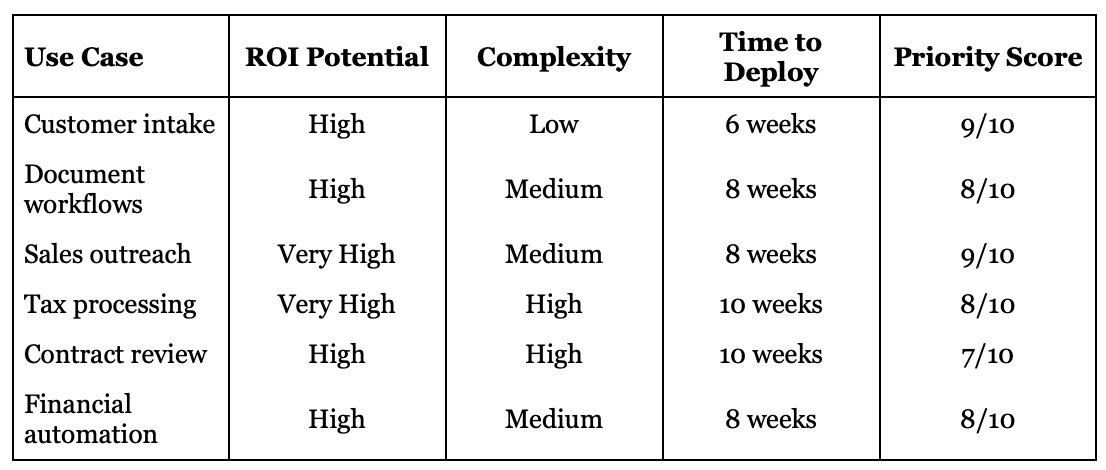
Use this decision matrix:
Dyntyx recommendation: Start with one high-impact, medium-complexity workflow. Prove ROI in 6–8 weeks. Then scale to additional use cases with confidence and momentum.
Chapter 7: Best Practices to Navigate the New World
The Seven Laws of Successful AI Agent Deployment
Law 1: Start with a Single, High-Volume Workflow
Why it matters: Companies that try to "boil the ocean" with enterprise-wide AI transformations almost always fail. Companies that start focused and expand systematically almost always succeed.
How to apply:
Choose one workflow that checks 4+ boxes: high volume, multi-step, structured, time-consuming, error-prone, bottleneck
Map the current process end-to-end with actual users
Identify the 60–80% that can be automated
Design clear escalation rules for the remaining 20–40%
Deploy, measure, optimize—then expand
Dyntyx approach: AI Strategy & PoC service specifically helps teams identify their single best first use case through AI readiness assessment and workflow mapping.
Law 2: Design for Human-in-the-Loop from Day One
Why it matters: The #1 reason employees resist AI agents is fear of loss of control. The #1 reason agents fail in production is lack of oversight when edge cases appear.
Create full audit trails so every agent decision is reviewable
Provide transparent reasoning: agents should explain their actions
Give humans override capabilities based on role
Include emergency stop functionality
Dyntyx approach: Human-in-the-loop design is built into every orchestrated agent system. Agents handle routine work, humans stay in control with clear escalation rules.
Law 3: Build Governance Before You Scale
Why it matters: Remember Gartner's prediction—40% of agentic AI projects will be scrapped by 2027 due to inadequate governance.
How to apply:
Risk Assessment: Categorize agent use cases by risk level (low/medium/high)
Policy Development: Document what agents can and cannot do
Monitoring & Controls: Track agent performance and detect anomalies
Escalation Protocols: Define when and how agents hand off to humans
Audit & Documentation: Maintain records for compliance and continuous improvement
Dyntyx approach: AI Governance & Risk service provides frameworks specifically designed for regulated industries—finance, healthcare, legal, accounting.
Critical insight: Organizations with formal AI governance report ~80% project success rates vs. ~37% for those without governance.
Law 4: Measure Business Outcomes, Not AI Vanity Metrics
Why it matters: "We deployed 47 AI agents!" sounds impressive but means nothing if they're not delivering business value.
Don't measure:
Number of agents deployed
Model accuracy scores
API response times
Lines of code
Do measure:
Hours saved per week (operational efficiency)
Cycle time reduction (days → hours, hours → minutes)
Revenue impact (conversion, upsell, capacity to take more clients)
Employee satisfaction (less busywork = happier, more engaged teams)
Dyntyx approach: Every engagement ships with explicit, measurable KPIs defined upfront. Weekly dashboards track progress toward business outcomes.
Law 5: Treat Agents as Employees, Not Tools
Why it matters: The best-performing AI agent deployments treat agents like new team members with clear roles, responsibilities, and performance expectations.
How to apply:
Give agents "job descriptions":
What workflows they own
What decisions they can make autonomously
When they must escalate to humans
What systems they interact with
Assign "managers":
A human owner responsible for each agent's performance
Regular reviews of agent outputs and escalations
Authority to adjust agent behavior and rules
Conduct "performance reviews":
Monthly dashboards showing agent KPIs
Analysis of escalations and edge cases
Continuous improvement based on data
HR perspective: 86% of HR leaders see integrating digital labor as core to their role—this isn't IT's problem alone[.
Law 6: Align IT, Operations, and Business Early
Why it matters: AI initiatives that start as IT projects or business-unit pilots without cross-functional buy-in fail at much higher rates[.
How to apply:
Create an AI steering committee with representatives from each function. Meet biweekly during deployment, monthly during optimization.
Dyntyx approach: Discovery phase explicitly includes stakeholder interviews and alignment workshops to ensure buy-in before building begins.
Law 7: Plan Your Workforce Strategy Explicitly
Why it matters: This is the elephant in the room. AI will free up capacity. What you do with that capacity defines whether you're a winner or a loser.
How to apply:
Step 1: Calculate freed capacity
Workflow time savings × frequency × hourly cost = annual value
Step 2: Decide your strategy
Option A (Cost reduction): 30% of freed capacity through natural attrition and hiring freeze
Option B (Revenue growth): 40% redeployed to sales, customer success, product development
Option C (Innovation): 30% redirected to R&D, new offerings, strategic initiatives
Step 3: Communicate clearly
Don't leave employees guessing about their future
Be transparent about which roles will change and how
Offer reskilling for roles most impacted by automation
Celebrate wins publicly: "AI freed Sarah to close 40% more deals this quarter"
Critical data: Research shows millions of U.S. workers have limited capacity to adapt to AI displacement without significant reskilling support[11]. Companies that invest in workforce transition see higher morale, lower turnover, and better AI adoption rates.
Bonus: The 8-Week Deployment Playbook
If you're ready to deploy your first agent system, here's the proven Dyntyx playbook that takes companies from strategy to production in 8–12 weeks.
Week 1: Discovery & Assessment
AI maturity scoring (1–100)
Workflow audit and bottleneck mapping
Quick-win use case identification
Stakeholder interviews
Week 2: Strategy & Planning
90-day transformation roadmap
Multi-agent orchestration design
Integration architecture planning
Governance framework setup
Weeks 3-4: Build Phase 1
Agent development with RAG-powered context
System integrations (CRM, email, project tools)
Escalation rule configuration
Security and compliance validation
Weeks 5-6: Testing & Refinement
Pilot deployment with limited workflows
User acceptance testing
Performance monitoring
Optimization based on real-world data
Weeks 7-8: Production Deployment
Full production launch
Team training and handoff
Monitoring dashboard setup
Initial performance reporting
Weeks 9-12: Optimization & Expansion
A/B testing and continuous improvement
Expansion to additional workflows
Scaling to more teams or departments
Preparation for next agent deployment
Expected outcomes by week 12:
20–40% operational time savings
30–50% cycle time reduction
Measurable ROI with clear path to expansion[2][3][4]
Chapter 8: Why You Shouldn't DIY This Transformation
The DIY Trap
You've read this far. You understand the opportunity. You see the data showing 20–40% efficiency gains and hundreds of thousands in annual value.
Now you're thinking: "We have smart engineers. We'll build this ourselves."
Here's why that's the riskiest move you can make.
The Hidden Costs of DIY AI Agent Development
Time cost:
Internal teams estimate 3–6 months. Reality: 12–18 months to production
Meanwhile, competitors with expert partners deploy in 8–12 weeks and capture market advantage
Expertise cost:
Multi-agent orchestration is fundamentally different from building apps or data pipelines
Most engineering teams lack experience with RAG architecture, agent coordination protocols, and production AI governance
Learning curve: 6–12 months before your team knows what they don't know
Opportunity cost:
Your best engineers spend 12+ months on internal AI infrastructure instead of core product/service innovation
Customer-facing projects get delayed or deprioritized
Revenue growth stalls while you "figure out AI"
Failure cost:
Remember: 40% of agentic AI projects are scrapped by 2027
DIY projects have even higher failure rates due to lack of governance frameworks and production experience
Failed projects destroy team morale and executive confidence in AI
What You're Actually Buying When You Hire Dyntyx
1. Speed to Value
Production-ready agents in 4–8 weeks vs. 12–18 months DIY
Measurable ROI from week one—no "pilot purgatory"
100+ active implementations across industries mean proven patterns, not experiments
2. Orchestrated Multi-Agent Systems (Not Single Bots)
Most DIY efforts build isolated bots that solve 20% of the workflow
Dyntyx builds coordinated agent teams that handle the full 80%—read, classify, route, execute, follow up, close loop
RAG-powered context awareness means agents understand your business, not just your data
3. Production-Grade Governance & Compliance
AI governance frameworks designed for regulated industries (finance, healthcare, legal, accounting)
Risk assessment, monitoring, audit trails, and escalation protocols baked in from day one
SOC2 certified and built for AICPA standards, IRS regulations, HIPAA, and state board requirements
4. Domain Expertise Across Industries
Vertical-specific AI solutions for accounting, financial services, legal, real estate, healthcare, and more
Pre-built agent templates for common workflows (intake, tax processing, contract review, bookkeeping, sales outreach)
Industry benchmarks so you know what "good" looks like
5. Outcome-Focused Engagement Model
Every project ships with explicit KPIs: hours saved, SLA improvement, error reduction, revenue impact
Weekly dashboards and monthly strategy reviews
Continuous optimization based on real-world performance data
6. Team Training & Long-Term Ownership
Your team is trained to manage and optimize agents long-term[
Change management support to ensure adoption
You own the system—Dyntyx doesn't create dependency
The Math: Build vs. Buy
Let's run the numbers for a mid-size company deploying an agent system for customer intake and document processing:
Real estate: Lead qualification, transaction coordination
Healthcare: Voice agents, patient communication
Investment: $6K–$20K/month or per-engagement pricing
Best for: Professional services firms in specialized industries
Success Stories: What Clients Say
"We went from 12-hour tax returns to 4-hour tax returns in 8 weeks. This paid for itself in the first tax season." — Partner, Mid-Size Accounting Firm
"Our sales team closed 31% more deals without adding headcount. The AI SDR handles prospecting and qualification 24/7." — VP Sales, National Tech Consulting Company
"We were losing 40% of potential clients to our onboarding process. Now we capture 100% of after-hours inquiries and convert 50% more." — Director, National Healthcare Organization
"The governance framework gave our board confidence to scale AI across the firm. We're now deploying agents in 5 departments." — CFO, Financial Services Firm
Three Calls-to-Action (Choose Your Path)
Path 1: Book a 30-Minute AI Agent Strategy Session
Free workflow audit
Identify your top 3 agent use cases
Get ballpark ROI estimate
No obligation, no sales pitch—just strategy
Path 2: Request a Custom AI Agent Roadmap (10-Day Delivery)
AI maturity assessment
Prioritized use case recommendations
90-day transformation plan
Budget and timeline estimates
Investment: $5K (credited toward engagement if you proceed)
Path 3: Launch an 8-Week Proof-of-Concept
Pick one high-impact workflow
Working agent in production in 8 weeks
Measure real ROI with your data
Decide whether to scale based on results
Investment: $25K–$50K
Conclusion: The 2026 Inflection Point
AI is not coming for jobs. It's already here.
The question is whether your company will:
A) Watch this happen by accident—competitors automate while you scramble, talent leaves, margins erode, and you become the "expensive, slow option" in your market.
B) Deliberately design an AI-augmented operating model that makes your company faster, more efficient, and more valuable—capturing the upside while competitors panic.
The data is clear:
AI displaced 200,000–300,000 U.S. jobs in 2025 and is accelerating
Companies deploying agents see 20–40% efficiency gains and 30–50% cycle time reductions
40% of AI agent projects will fail due to poor governance and strategy
Organizations with formal AI strategies see ~80% success rates vs. ~37% without
Production-ready agent systems can be deployed in 8–12 weeks with measurable ROI from week one
2026 is the inflection point. The companies that move decisively now will build competitive moats that late adopters can never close.
The winners won't be the ones with the best AI models. They'll be the ones with the best AI operating models—orchestrated agent systems with governance, human oversight, and clear business outcomes.
Not AI as a tool your team uses, but AI teammates that own workflow execution.
Dyntyx exists to make that transition fast, safe, and profitable. We've deployed 100+ agent systems across industries. We know what works. We know what fails. And we know how to get you into production in weeks, not quarters[2].
The AI transformation is happening with or without you.
The only question is whether you'll be leading it or reacting to it.